
Introduction
Choosing security software sounds easy. Until you start comparing options.
One antivirus promises better protection. Another claims faster performance. VPN providers talk about privacy, speed, and security, but their plans often look surprisingly similar.
That’s where Protect-IQ.com comes in.
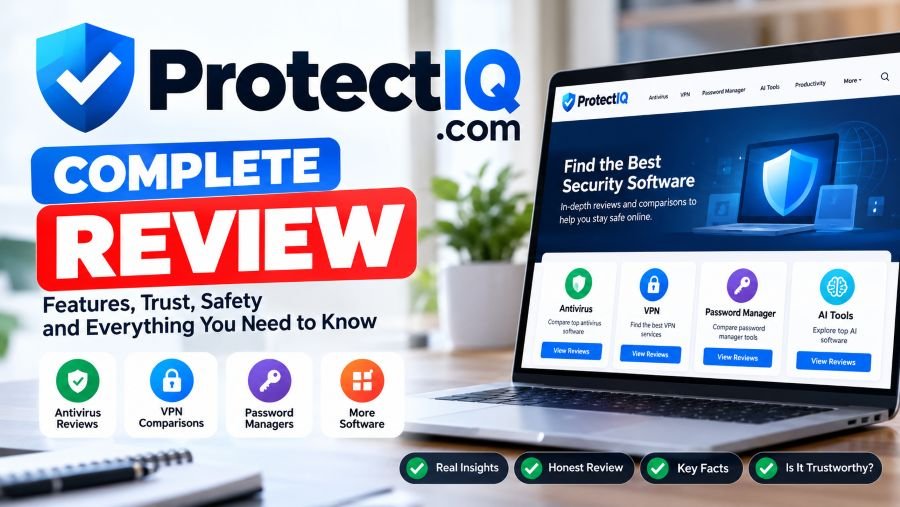
The website publishes software reviews and product comparisons. Its main focus is helping readers understand security tools before spending money.
But there’s another question worth asking. How reliable are its recommendations?
The site describes itself as an independent testing publisher. It also earns money through certain affiliate links. Both details matter when judging its content.
Here is what we found.
Quick Facts
| Detail | Information |
|---|---|
| Website name | ProtectIQ |
| Domain | protect-iq.com |
| Website category | Technology and software reviews |
| Main focus | Cybersecurity and software comparisons |
| Main language | English |
| Popular topics | Antivirus, VPNs, password managers |
| Other coverage | AI tools and productivity software |
| Content type | Reviews, rankings, comparisons, buying advice |
| Revenue model | Affiliate commissions |
| General email | info@protect-iq.com |
| Media email | press@protectiq.com |
| Website access | Free informational content |
| Reported testing approach | Product testing and weighted scoring |
| Review year | 2026 |
What Is This Website About?
ProtectIQ is a software comparison publisher. It covers products that people use to protect their devices, manage passwords, browse privately, and handle everyday computer tasks.
Its main idea is simple.
Compare products before buying them.
The website presents rankings, feature descriptions, pricing information, and explanations of how different tools work.
A reader searching for antivirus software, for example, can find several products arranged by editorial scores. Each entry may discuss protection features, performance, pricing, and the type of user it suits.
The same approach appears in its VPN comparisons.
Instead of selling its own antivirus program, ProtectIQ directs readers toward software made by other companies.
This distinction matters. It is mainly an information publisher, rather than a company providing the security applications it reviews.
What Kind of Software Does It Cover?
The platform has several content categories. Some have detailed comparison pages, while others appear as planned coverage on the homepage.
Antivirus and Internet Security
Antivirus software is one of its biggest subjects.
The website compares well-known products, including Bitdefender, Norton, McAfee, Avast, and other security providers.
Readers can check the features offered by different programs.
These may include malware detection, phishing protection, firewalls, password managers, and extra security services.
ProtectIQ also discusses how antivirus programs may affect computer performance.
That’s useful for older devices. Heavy security software can sometimes make a computer feel slower.
Still, users should confirm current product features before buying because subscription packages can change.
VPN Services and Online Privacy
VPN comparisons form another main section.
The website discusses providers such as NordVPN, ExpressVPN, Surfshark, and Proton VPN.
Its reviews cover connection speeds, privacy features, supported devices, and subscription choices.
Some comparisons include streaming support and server locations.
But remember one thing.
A VPN doesn’t guarantee complete anonymity. Its protection also depends on the provider, connection settings, and how someone uses the internet.
That makes independent verification important.
Password Managers
Remembering passwords isn’t easy anymore.
Many people have dozens of accounts. Using the same password everywhere creates unnecessary risk.
ProtectIQ publishes comparisons of password managers, including products such as 1Password, Bitwarden, and Dashlane.
These applications can help users store and manage login details.
The website discusses security features, ease of use, compatibility, and pricing.
Readers can use these comparisons to make an initial shortlist.
Artificial Intelligence Tools
The website has also published AI software comparisons.
These cover tools used for writing, coding, answering questions, and handling work tasks.
Products discussed include ChatGPT, Claude, and Gemini.
Its comparison approach considers factors such as practical usefulness, accuracy, and available features.
AI services change frequently, though. A rating published several months ago may not reflect a product’s current capabilities.
Productivity and Other Software
Project management is another category represented on the website.
It discusses tools such as Notion, ClickUp, and Asana.
The homepage also mentions creative software, development applications, web hosting, and privacy tools.
Some of these sections are advertised as coming soon.
So readers shouldn’t assume every listed category already has a complete review collection.
How Does the Testing Process Work?
ProtectIQ describes a structured testing system.
According to its published explanation, the process begins with obtaining and installing software.
Products are then assessed using tests suited to their category.
For antivirus programs, the claimed process includes security and performance checks. VPN testing focuses on connection speed, privacy features, and related functions.
The website also says products are checked in practical usage situations.
After testing, scores are assigned.
These scores consider several factors, including protection, performance, usability, available features, and value.
The homepage says rankings are retested monthly.
Sounds useful, right?
The important detail is verification.
ProtectIQ reports more than 200 tested products and over 4,800 hours of testing. It also claims to have helped more than 10 million readers.
Those are the website’s own figures.
Publicly reviewed information did not provide enough independent evidence to confirm those totals or fully reproduce its laboratory results.
A published score can help readers compare options. It should not replace independent test reports or checks against official product information.
How Does the Website Make Money?
The affiliate model is clearly described in its disclosure.
Some product links may generate commissions when visitors complete qualifying purchases or registrations.
Here’s a simple example.
Someone reads an antivirus comparison. They find a product they like and follow a purchase link.
If the visitor buys through a qualifying affiliate link, the publisher may receive payment from the software provider.
The customer generally doesn’t pay an extra fee simply because an affiliate link was used, according to the site’s disclosure.
Affiliate marketing is common among review publishers.
But it creates a question about independence.
ProtectIQ says compensation doesn’t automatically determine rankings. Its disclosure also states that commercial relationships may affect which offers can be featured.
That’s why checking more than one source makes sense.
A useful review should explain limitations as clearly as benefits.
Can Readers Trust the Rankings?
This deserves a closer look.
The website publishes substantial product information. Its pages also explain evaluation criteria and disclose affiliate relationships.
Those are useful signs.
Still, some concerns appeared during the website review.
One clear example involves Atlas VPN.
ProtectIQ’s VPN ranking, labelled March 2026, includes Atlas VPN among its listed services, complete with a pricing entry.
But Atlas VPN officially discontinued its service on April 24, 2024.
That’s a meaningful accuracy problem.
Someone reading the comparison in 2026 could reasonably assume the service was still available.
The problem doesn’t establish that every ranking is wrong. It does show why readers shouldn’t accept all details without checking.
There are other gaps.
The reviewed public pages do not clearly identify the company’s legal owner or individual testing staff. The homepage makes extensive testing claims, but supporting records weren’t sufficient to independently confirm them.
Its blog index also displayed a message saying no posts were found during the review, despite other areas advertising editorial articles.
These observations raise questions about content maintenance and transparency.
They do not, by themselves, establish dishonest activity.
Who Owns the Publisher?
Ownership details are limited in the reviewed public material.
The About page explains the site’s editorial purpose and commercial approach.
Its press kit describes the business as an independent software testing and comparison publisher.
However, those reviewed pages do not clearly name a founder or registered operating company.
There is also no independently verified headquarters information available from the material examined.
It’s better to leave these details unanswered than attach an unrelated business or individual to the domain.
Another point can cause confusion.
A separate network-security product called ProtectIQ is offered through Calix and various internet service providers.
That product should not automatically be associated with the software review website discussed here.
Similar names don’t establish common ownership.
Contact and Customer Support
The website provides a general contact email:
info@protect-iq.com
Its press kit also lists a separate media address:
press@protectiq.com
The contact page includes a message form and says responses generally take 24 to 48 hours.
The publisher accepts questions about its comparisons, editorial corrections, and partnerships.
But there is a limit.
It does not provide direct billing or account support for antivirus and VPN companies featured in its rankings.
For example, customers experiencing problems with a purchased VPN subscription need to contact the actual software provider.
The listed email addresses were not independently tested for deliverability.
What About Privacy and Personal Information?
Privacy matters on review websites too.
ProtectIQ publishes a privacy policy explaining the information it may collect.
This includes browser and device information, referral sources, page interactions, and details submitted through contact forms.
The website also says analytics services and cookies may be used.
Affiliate links can contain tracking information. That’s how qualifying referrals are often identified.
Its privacy policy states that personal information isn’t sold as a core business model.
Still, that statement is part of the publisher’s own policy, not an independent privacy audit.
Readers should avoid sharing unnecessary personal details through contact forms.
Never send passwords, account recovery codes, or payment card details when asking a review website for general advice.
Is It Free to Use?
The website makes its informational content available without requiring a paid membership for ordinary reading.
Visitors can check comparisons and read product descriptions.
However, the security programs discussed on the website may have their own subscription charges.
These payments go through the relevant software providers.
A free review website doesn’t mean every product it recommends is free.
Check the subscription terms carefully.
Discounts, renewal prices, supported devices, and refund policies can vary between providers.
Who Might Find It Useful?
The platform is mainly aimed at people comparing software before making a purchase.
A beginner who doesn’t understand antivirus features may appreciate having several products discussed in one place.
Someone choosing a VPN might want to compare privacy features and supported devices.
Small business owners may also find the software categories relevant.
But the information works best as a starting point.
Readers making important security decisions should compare the site’s claims with independent security testing and current information from the software provider.
This is particularly important for business systems or devices containing sensitive information.
What Should You Check Before Following a Recommendation?
A high rating looks reassuring.
It doesn’t tell the full story.
Start by checking the product’s current availability. Then confirm the subscription price and supported operating systems.
Look for recent independent tests.
A VPN should have credible privacy information. Antivirus software should have current malware-detection results from recognised independent testing organisations.
Also check refund terms.
A low first-year price may turn into a much higher renewal fee.
If a review contains outdated information, treat the rest of its details more carefully.
The same goes for vague testing claims that don’t explain how results were obtained.
A little checking now can prevent a costly mistake later.
Final Thought
ProtectIQ offers a convenient way to compare antivirus programs, VPN services, password managers, and other software products.
Its main appeal is accessibility.
Readers can view rankings, compare features, and learn about common security tools without needing advanced technical knowledge.
But its recommendations need careful reading.
The affiliate business model is disclosed, while some testing claims remain independently unconfirmed. An outdated VPN entry also shows that published comparisons can contain errors.
The website can be useful for initial research.
It should not be the only source behind an important software purchase.
The sensible choice is to read the comparison, check the current facts, and make your own decision.
Frequently Asked Questions
1. What is ProtectIQ?
ProtectIQ is a software review and comparison publisher. It focuses on cybersecurity applications, privacy tools, and other software categories.
2. Is the website legitimate?
It is an accessible publishing website with software comparisons, contact details, and legal policies. However, its ownership and several testing claims remain independently unverified. This does not establish fraud or complete reliability.
3. Does it offer free reviews?
Yes. Its public software comparisons and informational pages can be read without purchasing a membership.
4. Does it sell antivirus software?
It primarily publishes reviews and rankings of third-party software. Readers may be directed to providers through product or affiliate links.
5. How does the publisher earn money?
Its affiliate disclosure says it may receive commissions after qualifying purchases or registrations through selected links.
6. Who owns the website?
The legal owner was not confirmed from the reviewed public information. The site’s About page does not clearly identify a founder or registered operating company.
7. Are its software ratings independent?
The publisher says it uses editorial testing criteria. However, its laboratory claims and complete supporting test data were not independently confirmed during this review.
8. Can I contact its support team?
Yes. The general contact email listed on the website is info@protect-iq.com. The company handles editorial and comparison questions rather than account issues with third-party software providers.
