
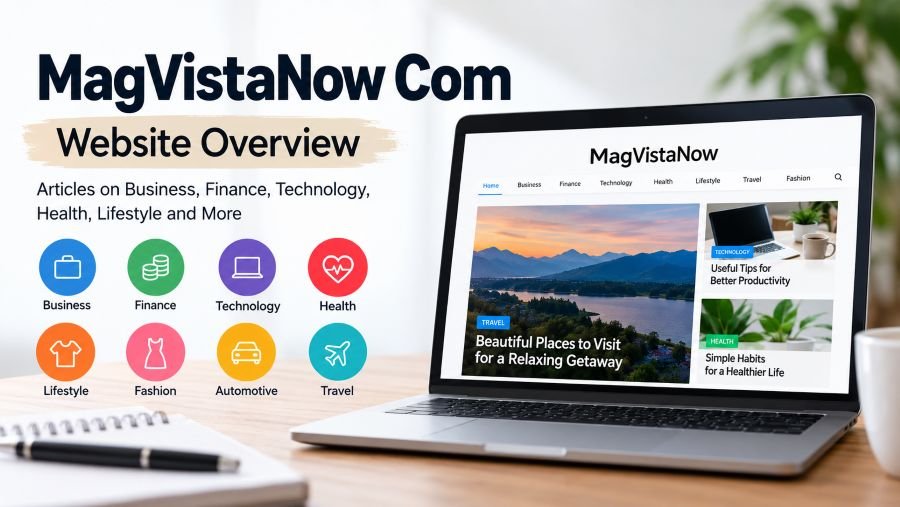
MagVistaNow com is a multi-topic online magazine. It publishes informational articles on everyday subjects. Readers can find guides, explanations, and general-interest content.
The website covers several areas. These include business, finance, technology, health, and lifestyle. Its content is aimed at people seeking basic information.
But how useful is it?
That depends on your needs. Some readers want quick answers. Others need detailed, expert-backed information. Understanding the difference can help you decide whether this website meets your expectations.
Quick Facts
| Detail | Information |
|---|---|
| Website Name | Mag Vista Now |
| Domain | magvistanow.com |
| Website Type | Online magazine and informational blog |
| Main Content | Articles, explanations, and practical guides |
| Language | English in verified indexed articles |
| Topics | Business, finance, technology, health, lifestyle, and related subjects |
| Publishing History | Articles indexed from at least August 2023 |
| Target Readers | General online readers |
| Founder | Not publicly verified |
| Current Owner | Not independently confirmed |
| Exact Launch Date | Not confirmed |
| Website Availability | Current access could not be fully verified |
What Is This Online Magazine?
Mag Vista Now is an online content publication. Its website contains articles on different subjects.
Think of a general-interest magazine. One page might discuss a banking question. Another could explain a technology issue.
That is the basic idea.
The website doesn’t focus on a single subject. Instead, it brings different article topics into one publication.
Its content appears suited to everyday readers. Many people search online for quick explanations. They want to understand something without reading a lengthy technical report.
That is where this type of publication can help.
Still, there’s a difference between general information and expert advice. Readers should keep that distinction in mind.
What Topics Does the Website Cover?
The publication has been described as covering several content areas. Its indexed article history confirms that it publishes practical informational material.
Here are the main subjects associated with its content.
Business and Professional Information
Business content is one of its reported subject areas.
This type of material can interest entrepreneurs, working professionals, and people researching business-related questions.
Readers should check individual articles carefully. A general explanation may be useful. But business decisions often need current information from official sources.
Finance and Banking
Financial information is another relevant subject.
There is a clear published example.
An article titled “Bank of India Mobile Number Change” carries an August 25, 2023, publication date.
The article discusses updating a registered phone number and the importance of receiving banking alerts.
This confirms that banking-related informational content has appeared on the website.
However, readers should always confirm banking procedures with their bank. Instructions can change. Security requirements can change too.
Technology and Online Services
Technology is another subject associated with the magazine.
Such articles may interest people looking for explanations of software, online services, and technical problems.
The main thing is accuracy.
Technical instructions should match the current version of a product or service. Older information may no longer work.
For important technical issues, official documentation remains the better reference.
Health and Everyday Living
Health and lifestyle are also mentioned in descriptions of the publication.
These subjects attract many readers. Everyday questions can be confusing. Simple explanations often make them easier to understand.
But health information needs special care.
A general website article cannot replace a qualified medical professional. Readers should check medical claims against reliable health organisations and clinical guidance.
Other General-Interest Subjects
The wider publication has also been associated with topics such as travel and fashion.
This broad approach gives the website room to cover different interests.
It also presents a challenge.
Readers may find useful information in one category while needing stronger sources in another. Content quality must be assessed article by article.
How Does the Website Work?
The basic format is familiar.
Mag Vista Now follows a magazine-style publishing model. Articles are organised around topics rather than personal accounts or transactions.
A third-party review published in 2026 described straightforward navigation and a simple article layout.
Here is how readers would normally use this kind of website:
- Open the main website.
- Look for an article or relevant category.
- Select the subject you want to read.
- Read the available explanation.
- Check supporting facts elsewhere when necessary.
The experience centres on reading information.
There is no verified evidence that the domain provides a personal banking dashboard, an investment account, or a financial transaction service.
That distinction matters because some online descriptions give a different impression of the website.
What Does Its Publishing History Tell Us?
The website has a documented article history.
One confirmed search-indexed post is dated August 25, 2023. It discusses changing a registered mobile number with Bank of India.
This shows that content associated with the domain was published by that date.
But it doesn’t establish the exact launch date.
A domain can be registered before its first article appears. Publishing might also begin before search engines record a page.
The same caution applies to article counts.
Without a complete and current website archive, there is no reliable basis for stating exactly how many articles the publication has released.
The available evidence supports a publishing history. It does not establish its full size or readership.
Who Might Find the Content Useful?
Different readers have different expectations.
Someone researching an unfamiliar subject might appreciate a short explanation.
A professional handling an important decision may need much stronger evidence.
The website may appeal to:
- Casual readers: People interested in general information.
- Students: Readers seeking an initial understanding before checking academic sources.
- Everyday internet users: People researching common questions.
- Business readers: People looking for introductory business information.
- Technology readers: Users seeking basic explanations of online topics.
These are possible reader groups based on the publication’s content. They are not verified audience statistics.
For serious research, published sources and author expertise matter more than a website’s appearance.
Is the Website Easy to Use?
A simple layout can make reading easier.
One published review described the website as having a clean design, readable articles, and straightforward category navigation.
The reviewer also reported occasional page errors.
These are observations from an external review, not confirmed results from a new technical audit.
During the October 2026 research check, direct requests to the homepage returned an access error. That does not prove the website is unavailable to every visitor.
Some servers restrict automated access.
The best way to judge the current experience is to check the website using a normal browser and see whether its pages load properly.
Is the Website Legitimate?
This is a reasonable question.
MagVistaNow com has a documented online presence. Search-indexed articles and outside references support its identity as a content publication.
That is a positive sign.
Still, the available evidence does not establish who owns the website or how its editorial review process works.
Its exact company registration details were not independently confirmed.
Does that automatically make it suspicious?
No.
Many smaller websites publish without extensive public company information. But limited transparency makes it harder to judge editorial accountability.
Readers should evaluate the quality of each article before accepting its claims.
Can Readers Trust the Information?
No website deserves automatic trust.
Accuracy depends on the subject, the evidence, and the author’s knowledge.
A general explanation may be useful even when it lacks specialist detail. But important decisions require stronger support.
Here are some sensible checks.
Look at the publication date.
An older article may contain outdated information. This matters particularly for banking, laws, software, and medical subjects.
Check the author’s identity.
A visible author name helps. Relevant qualifications can provide more confidence, especially in specialist subjects.
Look for supporting evidence.
Official records, published research, and primary documents make factual claims easier to verify.
Compare important instructions.
If an article recommends changing account settings or sharing personal details, check the official service instructions first.
Watch for unsupported promises.
Claims about guaranteed earnings, unusually strong results, or instant solutions deserve extra care.
These checks apply to any informational publication.
What About Website Safety?
Website legitimacy and technical security are different questions.
An established publishing history does not guarantee that every page is secure.
A third-party review reported no obvious harmful activity during its visit. That is useful context, but it is not a substitute for an independent security scan.
The website’s current technical security status was not established during this research.
Readers can still take basic precautions.
Avoid downloading unfamiliar files. Do not enter passwords into unexpected forms. Check the domain carefully before sharing personal information.
And remember, an article about finance is not proof that a website is authorised to offer financial services.
Who Owns the Publication?
The ownership question remains unanswered.
The available research did not independently verify the founder, current owner, registered company, or main editorial team.
Public author bylines alone cannot establish company ownership.
It would be misleading to name an individual without supporting evidence.
The same applies to the company’s headquarters, employee count, and estimated revenue.
Those details should remain unstated until dependable records are available.
Does It Accept Guest Posts?
The domain has appeared in a third-party guest-post marketplace listing.
That suggests outside sellers have advertised publishing placements associated with the website.
However, such a listing does not prove that the website owner directly approves those offers.
It also does not establish current prices, editorial requirements, backlink policies, or whether a purchased article would remain published.
Anyone considering a placement should confirm the terms directly with the responsible publisher.
For ordinary readers, the more important question is whether sponsored material is clearly identified and whether article claims can be checked.
What Makes It Different From Specialist Websites?
A specialist website concentrates on a limited subject.
For example, a dedicated technology publication may cover software and devices in greater detail.
A general online magazine works differently.
It brings several subjects together. That gives readers access to a wider range of topics without changing publications.
But broad coverage has limits.
A website publishing health articles may not have the same expertise as a medical organisation. Its banking content may not match official banking instructions either.
This doesn’t mean every general article is inaccurate.
It simply means readers should consider the source and the subject before relying on the information.
Strengths and Limitations
The website has some identifiable characteristics.
| Strengths | Limitations |
|---|---|
| Covers multiple subjects | Does not specialise in one topic |
| Has a documented publishing history | Exact launch date remains unverified |
| Offers general informational material | Individual articles need fact-checking |
| Has search-indexed content | Current traffic figures are not confirmed |
| Uses a familiar magazine format | Ownership and editorial details remain unclear |
These points describe the available evidence. They are not a scored website audit.
What Should Visitors Check Before Relying on an Article?
Start with the information itself.
Does the article answer the question? Is it recent enough? Are important claims supported?
Those questions matter.
For everyday subjects, a short explanation might be sufficient.
For medical, legal, or financial decisions, it usually isn’t.
Readers should confirm the details through qualified professionals or official organisations.
There is also the issue of changing information.
A banking procedure published in 2023 may differ from the procedure used in 2026.
Dates provide context. They don’t guarantee accuracy.
A careful reader checks both.
Final Thought
Mag Vista Now is a general-interest online publication with a documented history of informational articles.
Its broad content makes it relevant to readers researching different everyday subjects.
Still, several details remain uncertain. The current ownership, complete publishing record, and technical security status have not been independently confirmed.
So, is it worth reading?
It can be a starting point for basic information. Just don’t treat every article as a final authority.
Read carefully. Check the facts. Use official sources for important decisions.
That is the sensible approach.
Frequently Asked Questions
1. What is MagVistaNow com?
It is a multi-topic informational website. Its published content includes general articles and practical explanations about everyday subjects.
2. Is it a news website or a blog?
It is best described as an online magazine or general-interest blog. Its content covers several subjects rather than one specialist news area.
3. What kind of articles can readers find?
Its documented content includes banking-related guides. External reviews also describe coverage of business, technology, health, and lifestyle topics.
4. Is the website safe to visit?
Its current technical security has not been independently verified. A published review reported no obvious harmful activity, but that does not guarantee complete safety.
5. Who is the owner?
The current owner has not been independently confirmed through the available public information.
6. When was the website launched?
Its exact launch date remains unverified. Search-indexed publishing evidence goes back to at least August 25, 2023.
7. Is it free to read?
The available information describes an informational publishing website. Its complete pricing and subscription arrangements have not been independently verified.
8. Can its articles be trusted?
They may provide basic explanations. However, readers should confirm important claims using official records, reliable research, or qualified professional guidance.
