
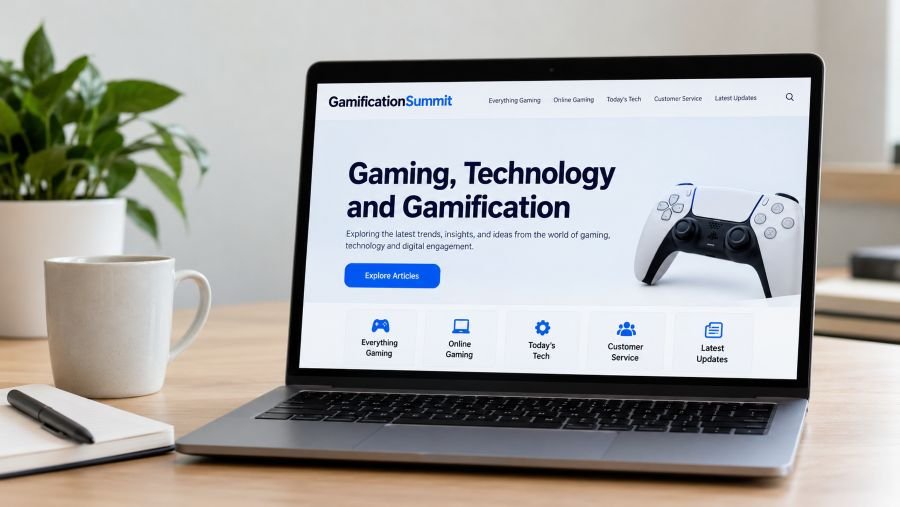
GamificationSummit.com is an online website covering gaming, technology, and gamification. It publishes articles about video games, digital rewards, online platforms, and gaming-related trends. Readers can also find content about customer service, online casinos, and event ticketing.
The name sounds like an event website. But there is more to it.
The current platform works mainly as an information blog. It shares articles rather than operating as a clearly verified conference booking service.
Still, a few questions remain. Who runs the website? What does it publish? And how reliable is its information?
Here is what the available evidence shows.
Quick Facts
| Detail | Information |
|---|---|
| Website Name | Gamification Summit |
| Domain | gamificationsummit.com |
| Website Type | Gaming and technology blog |
| Main Topics | Gaming, technology, gamification |
| Language | English |
| Listed Owner | Mark Baer |
| Named Contributors | Patrick Grier, Sarah Lawson |
| Domain Registration | August 12, 2010 |
| Domain Registrar | GoDaddy.com, LLC |
| Security | HTTPS supported |
| DNS Provider | Cloudflare |
| Website Status | Accessible during October 2026 research |
| Corporate Ownership | Not independently verified |
The ownership details come from the website’s own About Us page. Domain information comes from public registration records.
What Is This Website Actually About?
The website focuses on gaming and technology.
Its content covers several subjects. Some articles explain familiar gaming ideas. Others discuss software, online services, and customer behaviour.
Gamification is one main topic.
Basically, gamification means adding game-like features to activities that are not games.
Think about a learning app. It might reward students with points for completing lessons. A fitness app may offer badges for meeting weekly goals.
Those are simple examples.
The same ideas appear in business training, education, and customer loyalty programmes.
The website discusses these concepts alongside more general gaming topics.
Main Content Categories
Readers can find different subjects across the platform.
Gaming News and Player Experiences
Gaming content forms a large part of the site.
Articles cover video games, gaming habits, online gaming platforms, and player engagement.
Some content discusses rewards and achievements. Other posts look at games and their features.
The subjects vary quite a bit.
That gives readers different kinds of gaming information, though article quality still needs individual checking.
Technology and Digital Tools
Technology is another regular subject.
The site publishes material about software, smart technology, cybersecurity, and digital services.
Some posts explain technical ideas. Others discuss how people use technology in everyday life.
These articles may suit casual readers who want basic explanations without heavy technical language.
Rewards and User Motivation
This is where gamification comes in.
The website has articles covering points, badges, leaderboards, challenges, and progress systems.
These features appear across many apps.
For example, a language-learning app might show a daily streak. A workplace training platform may give employees badges after finishing courses.
The goal is often simple. Keep people interested.
But rewards do not guarantee success.
A badly planned points system can become frustrating. Good design needs a useful purpose behind the rewards.
Online Gaming and Casino Topics
The site also publishes casino-related material.
Some articles discuss gambling platforms, payment methods, player behaviour, and online gaming technology.
This content deserves extra care.
Readers should check licensing, local laws, and independent information before following gambling-related recommendations.
Who Owns and Writes for the Platform?
The website names Mark Baer as its owner.
Its About Us page describes him as a gaming enthusiast interested in technology and new developments within gaming.
It also introduces two contributors.
Patrick Grier is listed as an author covering gaming-related subjects. His name appears on several published articles, including event and ticketing content.
Sarah Lawson is presented as a writer interested in gaming and technology.
These are the site’s published descriptions.
Independent information confirming their professional backgrounds or the legal ownership of the website was not established during research.
That distinction matters.
An About Us page tells readers what a website says about itself. It does not automatically verify every detail.
Website History and Domain Background
The domain has a fairly long registration history.
Public records show that it was registered on August 12, 2010.
That makes the domain more than sixteen years old as of October 2026.
But there is a catch.
An old domain does not prove the current publishing team has operated it since the original registration date.
Domains can change owners. They can also change their content and purpose.
The available records do not establish the exact launch date of the current blog.
The domain uses GoDaddy as its registrar and Cloudflare for DNS services.
HTTPS is also supported.
These are normal technical features. They do not independently prove the accuracy of published articles.
The Connection With Historical Gamification Events
The site’s name raises another question.
Was it connected to the original Gamification Summit?
There really was an early industry conference using that name.
A documented Gamification Summit took place in San Francisco on January 20–21, 2011.
The event covered the use of game mechanics outside traditional gaming.
Speakers included Gabe Zichermann, Jane McGonigal, and Amy Jo Kim.
Contemporary accounts described strong attendance, with approximately 400 people at the event.
Later conferences also took place.
However, historical event coverage identified the GSummit brand and its associated organisers.
Research did not establish that the present GamificationSummit.com publishing website is operated by those same organisers.
So readers should keep them separate.
A shared name is not proof of a business connection.
What Kinds of Articles Can Readers Find?
The homepage includes many educational and gaming-related posts.
Examples of published topics include:
- What Is Gamification and How Does It Work?
- Points, Badges, and Leaderboards: Core Gamification Mechanics Explained
- Intrinsic vs. Extrinsic Motivation in Gamified Experiences
- Ethical Gamification: How to Engage Users Responsibly
- How Social Apps Use Streaks, Challenges, and Rewards
- Ways Gamification Can Improve Learning and Workplace Training
- How Gamification Can Support Long-Term User Engagement
These titles show a clear interest in game-based behaviour and user motivation.
Yet the website is broader.
It also carries online gaming articles, commercial subjects, technology posts, and numerous pages about past event tickets.
That mixture makes its editorial focus less consistent than a specialist gamification research publication.
Is the Website Easy to Understand?
Much of the material targets general readers.
Article titles explain their subjects directly. The content often uses familiar examples and accessible language.
That can help beginners.
Readers unfamiliar with digital rewards may understand the basics without needing specialist knowledge.
Still, easy writing is only one part of quality.
Accuracy matters more.
For technical advice, historical events, financial transactions, or regulated gaming topics, readers should check whether an article supports its claims with dependable evidence.
Some pages provide broad explanations. Others make specific claims that need stronger confirmation.
Can You Trust Its Information?
The website has several normal features.
It provides an About Us page, a contact page, published articles, a privacy policy, and terms and conditions.
These help visitors understand how the site presents itself.
But they cannot answer everything.
During research, some concerns appeared.
Limited Ownership Verification
The platform names its owner and writers.
However, independent records confirming its corporate operator were not established.
There is a difference between a published name and verified company ownership.
Questions About Contact Information
The Contact Us page includes a contact form and a postal address.
The published location details could not be verified as a genuine business location.
Readers should avoid assuming that an address is authentic simply because it appears on a contact page.
Event and Ticketing Claims
Several articles discuss conference tickets and registration methods.
Some historical ticketing claims are inconsistent across the website’s own content.
No clear independent confirmation was established for its claimed connection to certain later summit events.
For that reason, readers should verify organisers, venues, and payment arrangements independently before considering an event transaction.
Repeated Search-Focused Content
The website contains numerous articles targeting similar event and ticketing phrases.
Some titles repeat closely related keyword combinations.
This can make finding a specific answer difficult.
It does not prove the articles were automatically generated or that the website is fraudulent.
But it gives readers another reason to judge each article individually.
Is It Safe to Visit?
The domain supports HTTPS.
That means a browser can establish an encrypted connection with the website.
This is useful.
But encryption does not verify a publisher’s identity or guarantee that every article is correct.
A website can have a valid security certificate while still publishing questionable information.
For ordinary reading, visitors can assess the site as they would any other public blog.
For purchases or registration payments, extra checks are sensible.
Check the organisation involved. Confirm the event independently. Read the payment and refund terms before entering personal details.
Do not treat a familiar name as proof of official status.
How Does the Website Make Money?
The site publishes commercially oriented content, including gaming and online casino topics.
Its policies also discuss advertising-related technologies.
That suggests advertising may be part of its publishing model.
However, its exact revenue sources are not publicly established.
There are no verified figures for monthly income, advertising earnings, paid partnerships, or total business revenue.
It would be misleading to attach estimated financial numbers without reliable evidence.
What Makes the Platform Different?
Its subject range is one noticeable feature.
A reader searching for gaming information may also encounter material about business rewards, motivation, technology, or digital services.
That brings several interests together.
The site also has a domain registration dating back to 2010.
Still, its age alone says little about the quality of the current content.
And the broad mix has drawbacks.
Readers seeking specialist research may prefer publications with clearly identified experts, stronger references, and a narrower editorial focus.
The website may offer introductory information, but its claims deserve normal fact-checking.
Who Might Find It Useful?
The platform may interest casual gamers and people learning the basics of gamification.
Students might read its explanations of rewards and motivation.
Business readers may find introductory discussions about customer engagement.
Technology enthusiasts can find general articles about apps and online services.
But specialist use is different.
Someone making business decisions, selecting a gambling provider, or purchasing conference tickets should rely on stronger evidence than a single blog article.
Final Thought
GamificationSummit.com is an active gaming and technology content website with a long-registered domain.
Its articles cover familiar gaming subjects alongside gamification, software, user rewards, and commercial gaming topics.
Some content may help beginners learn basic ideas.
Still, there are gaps.
The website’s legal ownership remains independently unverified. Its historical conference connections are unclear, and certain ticketing claims need stronger supporting evidence.
The sensible approach is simple.
Read the articles for general information. Check important facts elsewhere. And never assume that a website represents an official event purely because its domain name sounds familiar.
Frequently Asked Questions
1. What is GamificationSummit.com?
It is a website publishing articles about gaming, technology, gamification, and related online subjects.
2. Who owns the website?
The About Us page identifies Mark Baer as its owner. Independent verification of its legal ownership was not established.
3. When was the domain registered?
Public domain records show a registration date of August 12, 2010. This does not confirm when the current website started operating.
4. Is it an official conference website?
Its present-day connection to the original Gamification Summit organisers has not been independently confirmed.
5. What is gamification?
Gamification means using game-like features, such as badges, points, and challenges, in activities outside traditional games.
6. Does the website cover casino gaming?
Yes. Its published content includes online casino and gambling-related subjects alongside general gaming articles.
7. Is the website secure?
The domain supports HTTPS. However, this does not confirm that its business claims, event information, or every article are trustworthy.
8. Can readers contact the website?
Yes. The site publishes a contact form. Its listed physical address was not independently verified during research.
