
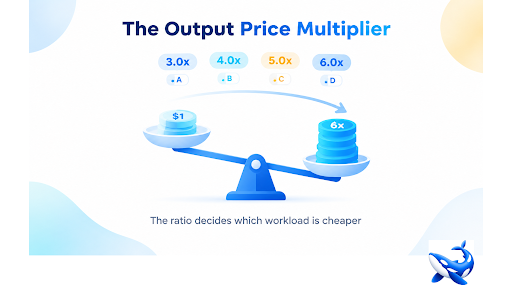
Every model card prints two prices, and almost every buyer reads only one. The input price gets the attention because it is the number a rate card leads with, but the output price is the one that decides a bill, and the ratio between the two — the output-to-input multiplier — is a property of the model that OrcaRouter makes visible in a single column of its llm model comparison. Across its twelve rows the multiplier runs from 3.0x to 6.0x, and that spread quietly decides whether a read-heavy workload or a write-heavy workload is the cheaper one to run.
The multiplier is the smallest column on the page and the one that controls your spend.
The four tiers of the multiplier
The table sorts itself into four bands. Two rows sit at 3.0x: DeepSeek V4 Pro at $0.66 input and $1.98 output, and Grok 4.7 at $2.00 input and $6.00 output. Two rows sit in the mid band between 4.0x and 4.2x: MiniMax M2.7 highspeed at $0.60 and $2.40, and kimi-k2.6 at $0.95 and $4.00. Five rows sit at 5.0x: the three Claude cards — Fable 5.1 at $10.00 and $50.00, Opus 5.5 at $4.00 and $20.00, Sonnet 5.5 at $2.00 and $10.00 — plus Gemini 3.8 Flash at $0.75 and $3.75, and GPT-6 Sol at $2.00 and $10.00. Three rows sit at the steepest 6.0x: Gemini 3.1 Pro Preview at $2.00 and $12.00, GPT-5.4 at $2.50 and $15.00, and GPT-5.5 Pro at $30.00 and $180.00. The multiplier is not a function of price tier: DeepSeek V4 Pro and GPT-5.5 Pro sit at opposite ends of the price column yet share the 3.0x and 6.0x bands with completely different neighbours.
The multiplier is also not a function of the quality column. On our composite score — our own in-house 0–10 across reasoning, instruction-following and reliability, not a third-party benchmark — Gemini 3.1 Pro Preview sits at 10.0 with a 6.0x multiplier, Claude Fable 5.1 sits at 10.0 with a 5.0x multiplier, and DeepSeek V4 Pro sits at 8.0 with a 3.0x multiplier. A model that bills its output at six times its input is not a better model; it is a differently shaped one, and the shape matters for the workload.
What the multiplier does to a read-heavy workload
A read-heavy workload — long document retrieval, a large corpus summarized once, a retrieval-augmented pipeline that sends a big context and gets a short answer — spends almost all of its tokens on the input side. For those workloads the multiplier is nearly irrelevant, because the output tokens barely register against the input volume. What decides the bill is the input price alone, and there the cheap-input rows dominate regardless of their multiplier: DeepSeek V4 Pro at $0.66, MiniMax M2.7 highspeed at $0.60, Gemini 3.8 Flash at $0.75. A read-heavy pipeline sending a 200,000-token input to MiniMax M2.7 highspeed and receiving a 2,000-token summary pays a 4.0x multiplier on an output that is a rounding error next to the input bill.
The read-heavy caution sits at the top of the table. Claude Fable 5.1 at $10.00 input is fifteen times dearer per input token than MiniMax M2.7 highspeed, and a read-heavy workload never earns that back through its 5.0x multiplier, because the multiplier applies to a tiny output. Teams that compare only the output column will pass over the correct answer, which is that a read-heavy bill is won on the input column and lost on nothing else.
What the multiplier does to a write-heavy workload
Flip the shape and the column flips with it. A write-heavy workload — long-form article generation, draft-then-iterate writing, code generation that emits a large completion per prompt, synthetic data pipelines — spends most of its tokens on the output side. There the multiplier becomes the dominant number, because it decides how many times the output price repeats the input price. Two rows with the same input price illustrate the point exactly: Claude Sonnet 5.5 and GPT-6 Sol both charge $2.00 input, but Sonnet 5.5 charges $10.00 output and GPT-6 Sol also charges $10.00 output, both at 5.0x. Compare instead a 3.0x row against a 6.0x row at similar input prices and the gap widens: Grok 4.7 at $2.00 / $6.00 against Gemini 3.1 Pro Preview at $2.00 / $12.00. On a million output tokens, the 3.0x row bills six thousand dollars and the 6.0x row bills twelve thousand — the multiplier doubles a write-heavy bill while the input prices sit identical.
That is why a write-heavy workload should read the output column first and treat the multiplier as the single most informative number on the page. A row like Gemini 3.1 Pro Preview, whose 6.0x ratio flatters nothing, is a row whose output price is worth holding against your actual output volume before any other comparison begins.

The two workloads on the same table
The multiplier decides which of two workloads is cheaper on any given row, and the table lets you play that out. On a read-heavy pattern, the cheapest bill comes from the cheap-input rows regardless of ratio: MiniMax M2.7 highspeed at $0.60 input, DeepSeek V4 Pro at $0.66, Gemini 3.8 Flash at $0.75. On a write-heavy pattern, the ratio takes over: among rows near each other in input price, the 3.0x rows — DeepSeek V4 Pro at $0.66 / $1.98 and Grok 4.7 at $2.00 / $6.00 — beat their 5.0x and 6.0x neighbours on every output-heavy bill, because their output price is proportionally so much lower. The same two rows that own the read-heavy table also own the write-heavy table, which is exactly why DeepSeek V4 Pro moved 512.0M tokens in the trailing seven days while the dearest cards moved a fraction of that: it wins both shapes at once.
Two numbers guard the rest of the picture. The 6.0x rows at the dearest end — GPT-5.5 Pro at $30.00 / $180.00 — are rows whose write-heavy bills escalate a hundred and eighty times per million output tokens, which is a statement about the model’s positioning, not its quality. And the context column still has to be checked before any of this arithmetic matters: a 300,000-token input already eliminates kimi-k2.6 at 262K and MiniMax M2.7 highspeed at 205K, whatever their multipliers say. GPT-5.5 Pro does not publish a context window at all, so its 6.0x ratio is a number on a row whose envelope is unverified. The latency column changes nothing about the multiplier, but two 6.0x rows — Gemini 3.1 Pro Preview and GPT-5.4 — sit at the 10.00 s ceiling, the cap of the measurement window, which is a reminder that the row that bills the most does not necessarily answer the fastest.
Choosing your multiplier band
A practical rule falls out of the four tiers. For a write-heavy service, prefer the 3.0x band — DeepSeek V4 Pro or Grok 4.7 — whenever the workload’s quality bar is met, because the output price is what you will multiply across millions of tokens. For a balanced workload, the 5.0x band of the three Claude cards and GPT-6 Sol is the standard shape of the market, and the input price inside that band is the tiebreaker. For a read-heavy workload, stop consulting the multiplier and sort by input price alone, because the ratio is a footnote against a large context. And for any workload, treat the multiplier as the column that converts the model’s price shape into your bill — the one number that separates a $0.66 row that bills like a budget card from a $30.00 row that bills like an enterprise contract.
The takeaway
The output-to-input multiplier runs from 3.0x to 6.0x across the twelve rows, and it is the column that decides which workload is cheaper on any given row. Read-heavy workloads spend their tokens on input and are won on the input price, making the multiplier a footnote. Write-heavy workloads spend their tokens on output, where the 6.0x rows bill double the 3.0x rows at the same input price. Read the table by your shape: sort read-heavy bills by input price, sort write-heavy bills by the multiplier, and only then bring in quality — our own in-house 0–10 across reasoning, instruction-following and reliability — and the context window. The multiplier will not tell you which model is strongest; it will tell you which model your bill can afford.
Sourcing note: All prices, multipliers, context windows and seven-day traffic figures are from the OrcaRouter comparison table and its linked model pages, read 2026-10-12; traffic is a rolling value that drifts. The composite quality score is our own in-house 0–10 across reasoning, instruction-following and reliability. All checked 2026-10-12.
